A Person and an AI Helping in One Interview: Who Does What
Yes, a person and an AI can help in the same interview if the company allows both, as long as each has a different job. The AI drafts from what it hears, your person keeps you on track with your real stories, timing and calm, and you give every answer in your own words. Neither belongs in a test, a proctored assessment, a recorded video interview or a take-home.
By Sam K., Founder, InterviewChamp.AI · Last updated
6 min readAbout the author: Sam K. is the founder of InterviewChamp.AI, which makes AI interview prep and a live interview helper, including Helper Mode. We sell a tool that does exactly this, so read it with that in mind.
TL;DR: If the company allows both, give the AI and the person different jobs. The AI drafts. The person keeps you honest about your own stories, keeps your pace and keeps you calm. You answer. When they disagree, what's true for you wins. And the best place to use both is practice, where nobody's permission is needed.
Can a person and an AI help in the same interview?#
Yes, if the company allows outside help and AI tools. Ask the recruiter first, and ask about both, because a yes to one isn't a yes to the other. If the company says no to either, drop it.
Where both are allowed, the trick is not to let them do the same job. Two sources telling you what to say at once is worse than one. Give each its own role and you get the best of both: the AI's speed and the person's knowledge of you.
The usual hard limit still applies. No help from anyone or anything during a test, a proctored assessment, a recorded video interview or a take-home.
The best place to use both is practice#
Before you plan a live setup, use the pair where nobody has to say yes: mock interviews.
- An AI mock interview asks you questions out loud, then scores your answers and shows what to fix, whenever you have time. You can practice with a mock interview on your own.
- A friend watches you answer, times you, and asks the follow-up question a real interviewer would ask.
- Together: run an AI mock with your friend watching. The AI asks, you answer, and your friend tells you which answers sounded like you and which sounded rehearsed.
Do two or three of these and you may find you don't want live help at all. That's a good outcome.
Who does what#
Here is a clean split for a live interview where the company allows both.
| Job | AI | Person | You |
|---|---|---|---|
| Hears the question and drafts an outline fast | ✓ | ||
| Knows which of your stories are true | ✓ | ||
| Remembers your real numbers | ✓ | ||
| Watches your pace and the clock | ✓ | ||
| Keeps you calm | ✓ | ||
| Spots a missing result or number | ✓ | ✓ | |
| Gives the answer | ✓ |
The last row is the one that matters. A live answer is a draft the AI writes from what it heard, and a hint is a short reminder from your person. Neither is your answer. Your answer is what you say, in your words, about things you actually did.
Behavioral rounds versus technical rounds#
The split changes with the kind of round.
- Behavioral interview: a person is most useful here. These answers come from your own life, and a friend who knows your work can remind you which story fits ("Story 3") or that you forgot the result. An AI can suggest a STAR method structure, which is situation, task, action and result, but it can't know what really happened.
- Phone screen with a recruiter: keep help light. These calls are usually short and mostly about your background and the role.
- Live technical discussion or system design: if help is allowed at all, keep it to the shape of your answer, like "Say the trade-off". You will be asked to explain your choices, so the thinking has to be yours.
- Coding test, online assessment or take-home: no help from a person or an AI. These are tests.
When the hint and the AI answer disagree#
It will happen. Your helper types "Use the dashboard project" while the AI drafts something about a different project. Agree on the tie-breaker before the call:
- True beats polished. If one of them matches what you really did, use that one.
- The person knows your facts. When the AI and your helper disagree about your own experience, your helper is usually right.
- If neither fits, answer from memory. You know your work. Hints are there for when you blank, not for every question.
- Take a moment. "Good question, let me think for a second" is a normal thing to say in an interview.
- Never read both. Pick one, glance at it, look back at the camera and talk.
How Helper Mode shows both#
Helper Mode is part of the InterviewChamp desktop app for Windows and Mac. One person you trust joins from a link in Chrome or Safari on their iPhone or laptop, and your AI answers keep working while they're with you. It works with Zoom, Google Meet and Microsoft Teams, it's on the Pro+ plan, and it's in beta.
You decide what shows. Show answers from is a switch in the Helper Mode window with three choices: your helper's name only, Both, or AI only. You can change it at any time, even mid-call.
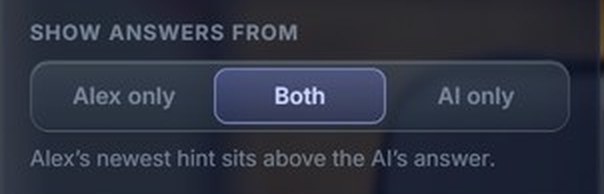
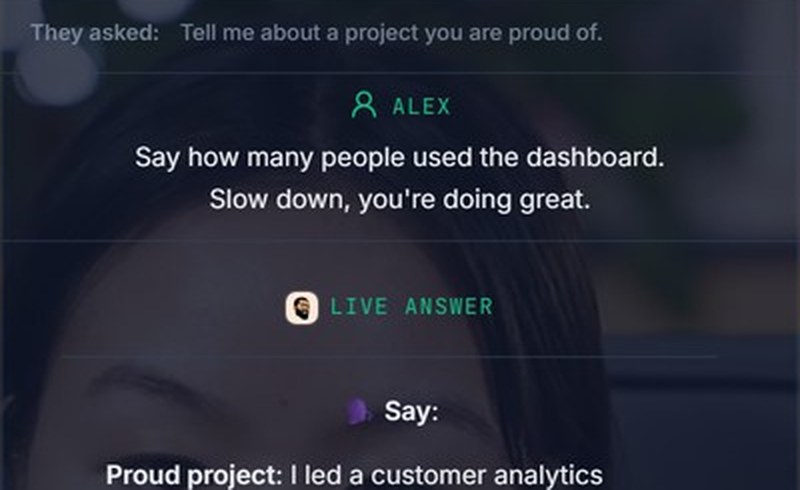
With Both on, your helper's newest hint sits above the AI's answer, with their name on it, so you always know which is which.
What your helper hears is separate. Switching off the interviewer or your microphone for your helper only changes what they hear. The AI still hears both sides. The full details are on the Helper Mode help page.
Why the answer has to be yours#
Interviews are built to test you, not your tools. A review covering 85 years of hiring research by Frank Schmidt and John Hunter found that structured interviews, where every candidate gets the same planned questions, predict job performance better than loose, unplanned chats. Companies interview because they want to know how you think.
And interviewers often ask "why?" after an answer. That follow-up is where a read-out answer falls apart.
So use both helpers as a safety net. If you can't explain an answer when the interviewer asks "why?", it wasn't your answer.
How to set it up#
- Get the company's yes for both. Ask the recruiter in writing whether a helper and an AI tool are allowed.
- Give each a job. The AI drafts. Your person reminds you of your stories, numbers and timing.
- Pick what you see. In Helper Mode, Both is on when your helper joins, with their hint on top. If two sources at once feels like too much, pick one before the call.
- Agree on a tie-breaker. What's true for you wins. Put it in your helper brief.
- Practice together. Run a 30-minute mock with both at least 24 hours before.
Common mistakes#
- Giving both the same job. Two drafts at once means you read instead of talk.
- Letting the AI tell your stories. It doesn't know what happened. Your helper and your memory do.
- Asking about only one. A yes to a helper is not a yes to an AI tool, and the other way round.
- Reading out the AI answer word for word. The follow-up question will show it.
- Using either in a test. Coding tests, assessments, recorded interviews and take-homes are always solo.
Related guides#
- Can someone help me during an online interview?: when outside help is allowed and how to ask.
- How to brief your helper before an online interview: the one-page brief, hint signals and the practice run.
- The AI interview helper guide: practice helpers versus live helpers, and how to use AI honestly.
Key terms#
- Live answer
- A draft answer an AI interview helper writes from what it hears in the call.
- Hint
- A short reminder from a person helping you, such as "Slow down" or "Add the number".
- Structured interview
- An interview where every candidate gets the same planned questions.
- Helper Mode
- An InterviewChamp feature that lets one trusted person join your live call from a link and send you hints.
Originally published on InterviewChamp.AI
Related guides
AI Interview Assistant Feature Comparison: 12 Tools Side by Side
Most AI interview assistants now offer live answer suggestions and mock interviews. What actually differs is the size of the free plan, the plan length (weekly, monthly or lifetime), phone apps, coding help and whether a friend can help on the call. This page puts twelve tools in three feature tables, using only what each tool's own site says. We make InterviewChamp, so check anything that matters on each tool's page.
Sam K. ·
Read more →Best AI Interview Assistant for Coding Interviews: 9 Tools Compared
There is no single best AI interview assistant for coding interviews. To practice coding interviews out loud with feedback, pick by need: a mock with a real person, an AI mock, or a problem bank, and treat live coding copilots as tools for live rounds only where the company allows them. This page compares nine tools by name, with prices from each tool's own site. We make one of them, InterviewChamp, so check every price yourself.
Sam K. ·
Read more →Beyz AI Review: Pricing, Plans and Who It Is For
Beyz AI has three paid plans: $49.99 a month month-to-month, $32.99 a month billed quarterly, or $24.99 a month billed every 6 months. Only the two longer plans include its Coding Assistant, and you can start free without a card. This page covers what each plan includes, the up-front totals, and who it fits. We make a competing tool, InterviewChamp, so check every price on Beyz AI's own page.
Sam K. ·
Read more →Frequently asked questions
- Can a friend and an AI help me in the same interview?
- Only if the company allows outside help and AI tools, so ask the recruiter first. If it does, split the work: the AI drafts from what it hears, your friend reminds you of your real stories, numbers and timing, and you give the answer in your own words. Never use either during a test, a proctored assessment, a recorded video interview or a take-home.
- What does a person do better than an AI in an interview?
- A person who knows you knows which stories are true and which numbers are real. They notice when you are rushing or nervous, and they can tell you to slow down. An AI only knows what it hears in the call and what you gave it.
- What should I do when my helper's hint and the AI answer disagree?
- Go with what is true for you. Your helper usually knows your real experience better than the AI does. If neither fits, answer from memory, and if you need a moment, say 'Good question, let me think for a second.' Never try to read both.
- Should I use a helper in a behavioral interview or a technical interview?
- A person helps most in behavioral rounds, because those answers come from your own stories, and a friend can remind you of the right one. In live technical discussions, keep any help to the structure of your answer. In a coding test, an online assessment or a take-home, there is no help at all.
- Can I choose whether I see my helper's hints, the AI's answers or both?
- In InterviewChamp's Helper Mode, yes. The Show answers from switch in the Helper Mode window offers your helper's name only, Both, or AI only, and you can change it at any time. With Both, your helper's newest hint sits above the AI's answer.
- Does the AI still hear the call if I switch off what my helper hears?
- Yes. In Helper Mode, switching off the interviewer or your microphone only changes what your helper hears. The AI still hears both sides, so its answers keep working.
- Is it cheating to use a person and an AI in an interview?
- It depends on what the company allows. Help the company agreed to is not cheating. Hidden help is, whether it comes from a person, an AI or both, because the company thinks it is judging you alone.
- What is the best way to use a person and an AI together?
- In practice before the interview. Run mock interviews where an AI asks the questions and scores your answers, and a friend watches, times you and asks follow-up questions. None of that needs anyone's permission.